How Many Musicians Do You Need for a Cocktail Hour?
The usual number is one to four. The role of the music is to accompany the moment, not to dominate it. It should be ambient, never loud enough to disturb a conversation, and still add something to the hour: an atmosphere, a visual, an artistic touch. That is what live music brings to a cocktail that a playlist cannot.
This is also why the group stays small. A cocktail band has to remain discreet. Beyond four musicians, you are no longer building a background to your conversations, you are building a concert, and that belongs to the dance floor.
Within that range, there are four formulas. I will describe each one, with what it sounds like, how much room it takes, and who it suits. Each has a video, so you can judge by ear and by eye rather than by description.
What Does a Solo Singer Bring to a Cocktail Hour?
The lightest formula is a single singer, accompanied by prerecorded backing tracks. It needs about one square meter, which makes it possible almost anywhere: a terrace corner, a staircase landing, a small salon.
Do not mistake light for ordinary. A beautiful voice, even alone, changes what guests experience during the hour. There is someone to look at, someone to listen to, someone to talk about. The repertoire, jazz, international and French songs, carries the room. The accompaniment is recorded, so it is less original than live instruments, but a good voice still makes a real difference compared to a playlist.
If you are working with a limited budget or a small space, this is a sensible place to start. Watch the solo singer formula.
A saxophonist is another option for a single performer. The saxophone is jazzy and light, and it can be virtuosic. It is a good choice for a cocktail, though the voice remains the instrument that carries the most emotion.
What Does a Voice and Guitar Duo Sound Like?
The second formula is a duo: a singer and a guitarist. It takes about three square meters.
This is the intimate version. The sound is clear, transparent and warm, and it puts the singer's voice forward, with nothing in the way. For a small gathering, or a moment of the day that calls for quiet, a voice and guitar can be very beautiful. You hear every word, every nuance of the interpretation.
Real instruments also change the nature of the music. A guitar does not play the same arrangement as a backing track. It follows the singer, breathes with her, and adapts to the room. That is already a step up from recorded accompaniment, and it keeps the footprint small.
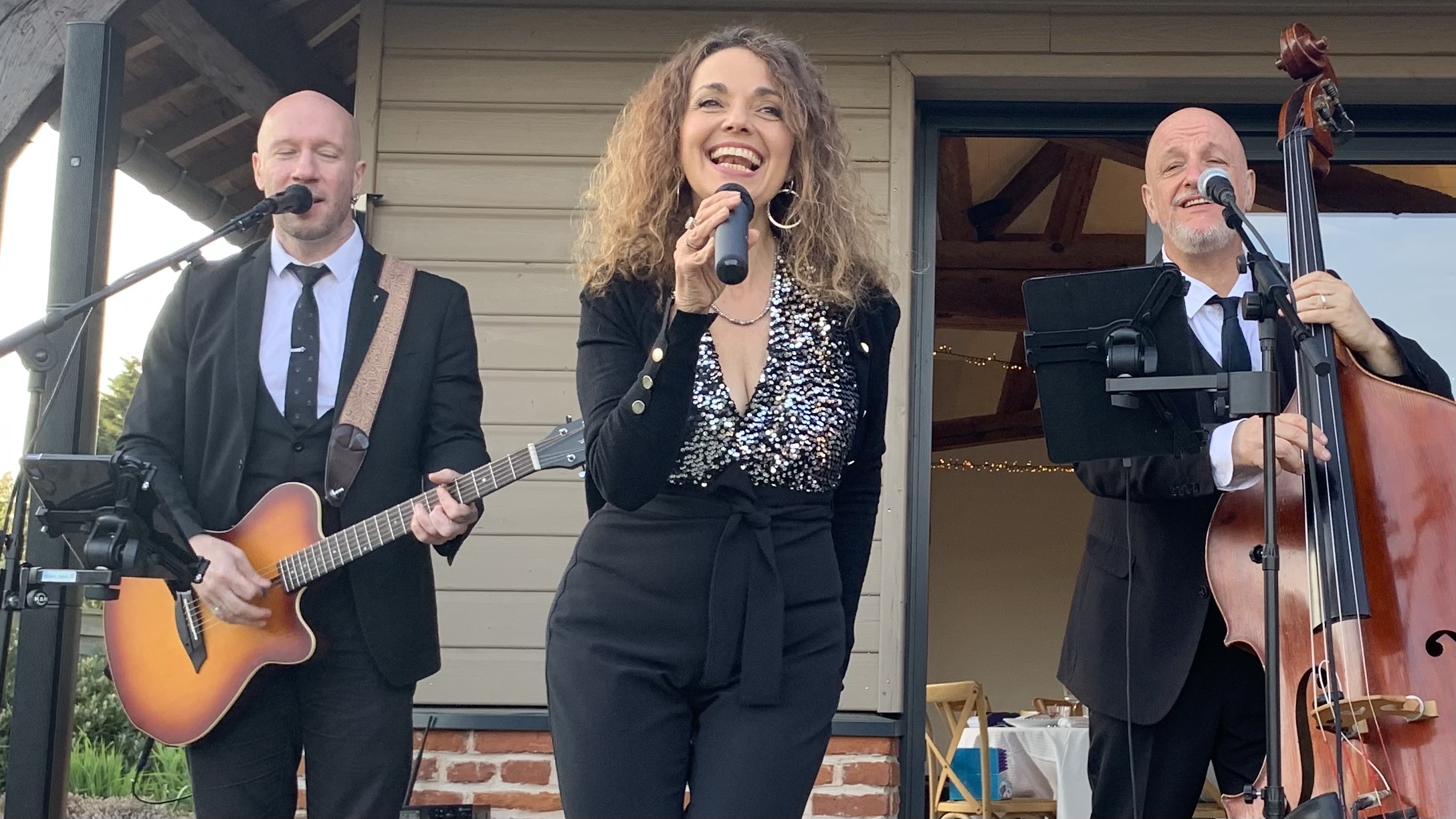
Why Does a Trio With Double Bass Feel So Different?
The third formula is a trio: a singer, a double bass and a guitar. It needs about four square meters, and a single electrical outlet.
The double bass is what makes the difference. It brings a warm, rounded, muffled sound that fills the low end the way nothing else does, and it gives the group a depth a duo does not have. It is also a beautiful object. A double bass in a room is a visual in itself, and guests notice it. The trio looks elegant, sounds authentic, and takes very little space.
This is the formula I would suggest to most couples. It brings real instruments and specific arrangements, with a version of each song made for the group. It sounds like something your guests have not heard before, and that is exactly what gives a cocktail hour its character. Watch the trio.
Because the trio uses a modest sound system and a single outlet, it adapts to almost any venue. If you are curious about how this fits into a full wedding day, you can read more about live music for the cocktail hour.
What Does a Percussionist Add to the Quartet?
The fourth formula is the trio with a percussionist added. It is a group of four and needs about six square meters, still with a single electrical outlet.
What the percussion changes is simply the rhythm. It adds a pulse, and that makes the music richer, easier to dance to, and more organic in its warmth. The sound feels fuller, and the room moves with it more naturally. If you have guests who like to dance a little during the cocktail, which does happen once the room has warmed up, a percussionist makes it easy.
This is not a drum kit. A cocktail band never has a full drum kit. The percussion stays acoustic and discreet, in keeping with the role of the group: to enrich the hour without covering the conversations. See the quartet formula on our formulas page.
How Much Space Does Each Formula Need?
Space is a practical way to choose. Here is what each formula needs on the floor:
- Solo singer: about 1 m².
- Duo, voice and guitar: about 3 m².
- Trio, voice, double bass and guitar: about 4 m².
- Quartet, trio with percussion: about 6 m².
The trio and the quartet need only one electrical outlet. This is why a cocktail band adapts to almost any space. You do not need a stage, and you do not need technical installation. You need a corner of a terrace, a corner of a hall, or a spot beside the bar.
When you plan your venue, tell your musician the size of the space where the cocktail takes place, and the position of the nearest outlet. This is usually all that is needed to settle the logistics.
Describe your cocktail space and we will suggest the right formula
Does Your Guest Count Decide the Number of Musicians?
Partly, but not as much as people think. Space and guest count are good guides. A very intimate wedding, with thirty or forty guests, does not necessarily need a group of four.
But it is a matter of taste as much as a matter of size. You can be few in number and still want a trio or a quartet, simply because you want a richer, fuller musical result. The more musicians there are, the richer and more developed the accompaniment is. That is a legitimate reason to choose a bigger group, whatever your guest list.
The reverse is also true. A singer with a guitarist can be very pretty even for a larger gathering, if the space is open and the music is meant to stay in the background. A voice and guitar sounds intimate and clear, and it brings out the beauty of the singer's voice. There is no rule that more is always better.
Which Formula Is the Best One?
If you have the space and the budget, the quartet is the most beautiful formula. The rhythm of the percussion, the warmth of the double bass, and the visual of four musicians together create the fullest cocktail.
The trio comes next. The double bass is the key: its warm, muffled sound is what makes the group feel authentic, and the instrument itself is lovely to look at. For many weddings, the trio is the best balance between richness, space and discretion.
Then comes the duo, for a more intimate sound. And then the solo singer, for the lightest footprint and the simplest setup. Every one of these formulas is a real step above a playlist. The choice depends on your space, your budget, and the atmosphere you want to give to the hour.
What Matters More Than the Number of Musicians?
The number of musicians is not the essential point. Quality is. A professional group, with a very good singer, will make a cocktail hour better than a larger group that is only competent.
There are a few simple ways to judge this.
First, watch videos. This is the best tool you have. A video shows you the sound, the image, and the level of professionalism of the group, far better than a description.
Second, ask for the repertoire. A list of songs tells you whether the group plays music you like. You can then see whether the style fits what you imagine.
Third, make sure you can communicate in English with the person who leads the group. This matters more than people expect. Many cocktail singers do not speak English well. They do not pronounce the words correctly, and they do not sing the English lyrics correctly. This is not always visible in a description, but it is always visible in a video. If your guests are English speakers, a singer who handles the language with ease makes an enormous difference to the experience.
If you want a list of everything worth asking before you hire anyone, our article on questions to ask potential wedding musicians before you book covers it in detail.
How Long Should the Cocktail Group Play?
A cocktail group is not limited to the cocktail hour. It can also play at your ceremony and during dinner, and you can book one of these moments, two, or all three.
At the ceremony, the group plays a few songs while guests take their seats, then marks the entrances, the key moments and the exit, for about thirty minutes of music. The cocktail hour follows, and the group can play from the first minute to the last. If your cocktail runs longer, the musicians typically play two sets of about 45 to 50 minutes, with a break of around twenty minutes between them.
Dinner is the third moment, and it suits a cocktail group particularly well. The sound stays soft, so guests can eat and talk without raising their voices. The group begins once everyone is seated and plays for the length of the meal, about an hour and forty five minutes.
Whatever the moment, the principle is the same. The music rises a little as guests settle, and it leaves space for conversation. A quiet first set and a livelier second set work well for many couples. Others prefer to keep the whole evening calm and cozy. Tell the musicians which atmosphere you want, and they will build it with you.
Talk to Nourith about the right cocktail formula for your wedding
Frequently Asked Questions
How many musicians do I need for a cocktail hour?
Between one and four. A solo singer with backing tracks, a duo, a trio or a quartet all work. Choose according to your space, your guest count and the richness of sound you want.
Is a singer and guitarist enough for a wedding cocktail?
Yes. A voice and guitar sounds intimate and clear, and it highlights the singer's voice. A larger group adds richness, but a duo is a beautiful choice if the singer is excellent.
How much space does a cocktail band need?
About 1 m² for a solo singer, 3 m² for a duo, 4 m² for a trio and 6 m² for a quartet. A trio or quartet needs only one electrical outlet.
What does a percussionist add to a cocktail band?
A rhythmic pulse. The music becomes richer, warmer, more organic, and easier to dance to, without the volume of a drum kit.
In Practice
The usual cocktail group has between one and four musicians, and every formula is a real improvement over a playlist. The quartet is the fullest, the trio is the best balance, the duo is the most intimate, and the solo singer is the simplest. Whichever you choose, the quality of the singer and the professionalism of the group matter more than the number of people on the floor.