Do Paris Venues Have Sound Limits, and What Does That Change?
Inside Paris itself, sound limits are common, though not universal. A number of venues outside the city let you use whatever volume you want. Inside the city, the picture is much less consistent, and this is exactly the kind of detail that needs to be settled before you sign anything with a venue. Many venues prefer not to bring this up early, treating it as a minor detail, when for some couples it is actually a decisive factor in how their evening will feel.
Not every limit is workable. Most venues that impose one allow somewhere between 110 and 120 decibels, which still leaves room for a genuine celebration. Some venues, however, cap sound at around 90 decibels, and this is not a workable limit for a wedding. At 90 decibels, guests cannot really feel the music or comfortably dance to it. In my view, this alone is reason enough to turn down a venue, however beautiful it is otherwise, if music and dancing matter to your evening.
What Does a Typical Sound Limit Actually Allow?
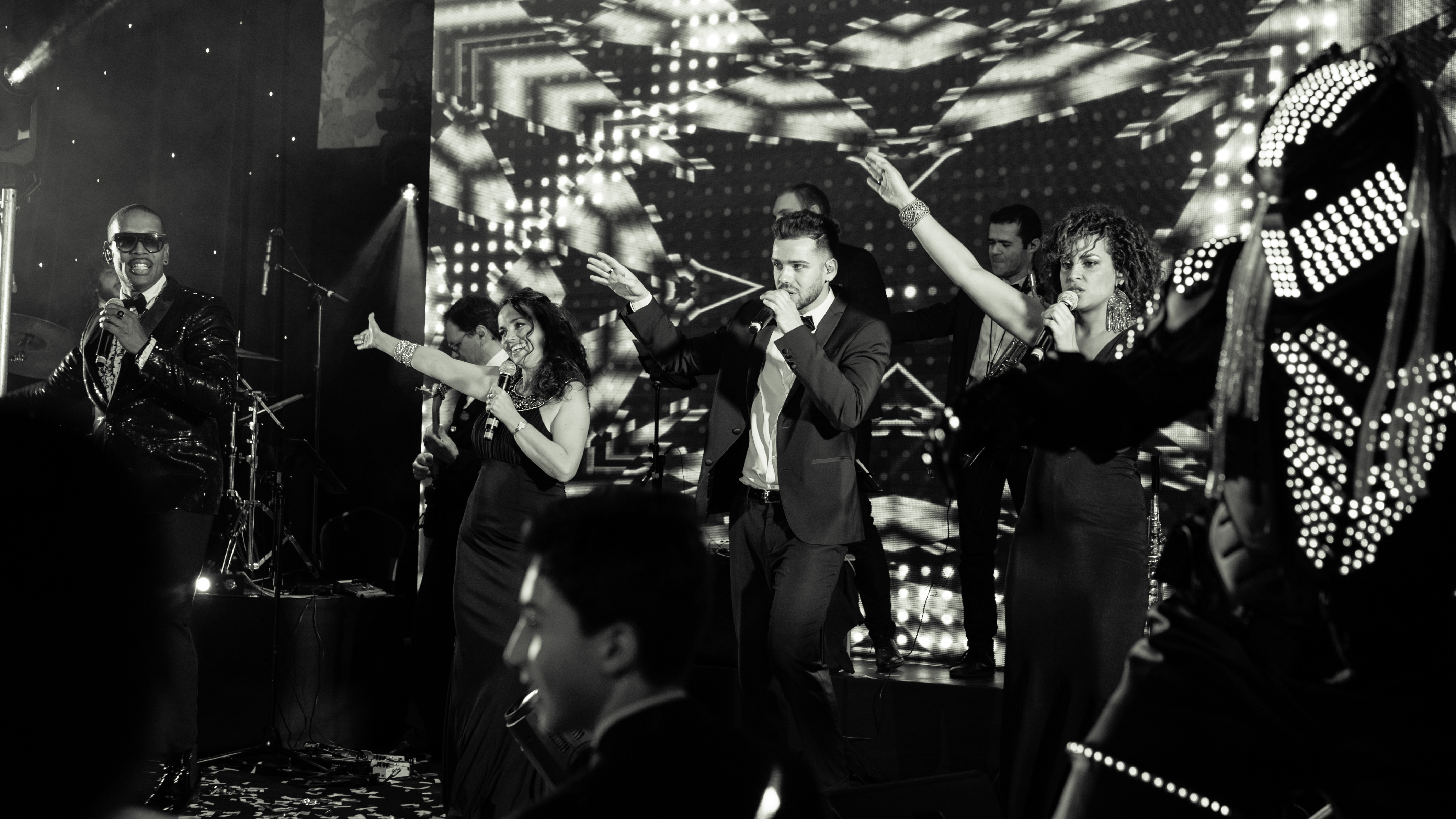
Where a workable sound limit exists, it is usually set somewhere between 110 and 120 decibels. This is a reasonably generous range. It allows a cocktail band to perform without any issue, and a DJ to mix at a volume that still feels energetic. You can even have a DJ-Live format, a DJ working alongside musicians and several singers, within this range. 120 decibels is loud enough to dance to and to genuinely celebrate, without becoming deafening.
In some cases, this limit actually works in a couple's favor. Many guests, particularly older family members, find themselves uncomfortable with the volume a DJ or a full live band typically generates during the dance floor portion of the evening. A capped volume can mean a more pleasant evening for a wider range of guests, not a diminished one.
What a Sound Limit Does Not Allow
What this kind of limit does not comfortably accommodate is a full live band playing for the dance floor with a real drum kit. A drum kit forces every other instrument to play at a correspondingly high volume simply to be heard alongside it, and a good sounding full band performance requires a certain baseline volume to actually work as intended. If your venue enforces a strict sound limit and you are picturing a full orchestra with drums for your dance floor, this is a conversation to have with your venue and your musicians well in advance, since it may change what format is realistically possible in that space.
How Do Musicians Actually Adapt When There Is a Limit?
In practice, when a sound limit is known in advance, it simply shapes which instruments are brought into the lineup. A cocktail band is never affected, since it was never built to play loudly in the first place. For a dance floor lineup, knowing a venue's limit means leaving out a drum kit and heavy percussion from the start, rather than discovering mid evening that the sound needs to be pulled back. When this is planned properly ahead of time, the result works well every time. Guests still dance, the atmosphere still builds, and nothing about the evening feels compromised. The problems only arise when a limit is discovered too late to plan around it, forcing changes on the spot rather than in the preparation stage where they belong.
What the equipment itself costs, and why a bigger room needs more of it, is broken down in what is included in a DJ package.
Ask us how sound limits affect your format choice
Is There a Pattern to Which Venues Have Limits?
There is no reliable way to predict in advance which venues will have a strict sound limit and which will not, whether by neighborhood, by arrondissement, or by the type of venue itself, a rooftop, a private mansion, or a classic reception hall. What actually determines a limit has less to do with the venue's category and everything to do with its neighbors, and how sensitive that particular neighborhood is to noise. Two similar venues a few streets apart can have completely different rules, simply because one has closer or more vocal neighbors than the other. This is exactly why the question always needs to be asked directly, rather than assumed from a venue's location or style.
Boats: A Special Case Worth Knowing About
Boats on the Seine are another category where sound limits come up often, and in a more restrictive way. Many of them prohibit music entirely on the outdoor deck. This can genuinely take something away from the celebration. Most couples want music, whether background music or a live group, to accompany their cocktail hour on deck, since almost no one wants that particular, privileged moment left without any music at all.
I have worked with several clients who ran into exactly this problem, and it seems that in more than one case, they were not warned about it in advance, which created real tension between the couple and the boat's management once it came up.
I experienced this myself once, when I was asked to sing for an outdoor cocktail on a beautiful boat. The venue required that I use their own sound system, in order to control the volume myself. This turned out to be a poor solution. Their equipment was not good, the sound quality was mediocre, the microphone kept cutting out, and I was unable to deliver the performance the way it should have been. If a venue offers, or requires, its own equipment, it is essential to check with your musician or performer in advance whether that equipment is actually suitable, rather than presenting them with it as a fait accompli on the day itself.
When a Venue Requires You to Use Its Own Speakers
In other cases, venues require that their own speakers be used for sound diffusion, while your musical provider brings everything else: a mixing table, microphones, monitors, and so on, feeding into the venue's own speaker system. Here again, always ask your musician or performer whether this equipment will actually work for their needs. It is worth asking the venue for the technical specifications of their equipment and passing those details along to your musical provider ahead of time, so any issues can be caught and solved before the wedding day, not during it.
How Do You Actually Get a Straight Answer From a Venue?
The most reliable approach is simple, though many couples skip it: when you first speak with a venue, ask directly whether there is a sound limit in place. If the answer matters enough to your plans, and it usually should, ask for that answer in writing. Sales representatives at a venue are, understandably, focused on making the sale, and an answer given verbally in a first conversation is not always precise, or may not fully reflect the reality of that specific space. A written confirmation protects you from a vague or overly optimistic answer given in the moment, and it gives your musicians something concrete to plan around well before the wedding day.
What Should You Ask Before You Sign With a Venue?
Given how differently venues handle this question, the right approach is to ask directly, early in the process: is there a sound limit, what is it measured in decibels, and does it apply throughout the evening or only after a certain hour. Ask for this in writing whenever possible. If the venue requires its own sound equipment for any part of the event, ask for the technical specifications and share them with your musician before booking is finalized. If music is restricted or prohibited in certain areas, such as an outdoor deck or terrace, find out exactly where those restrictions apply and whether there are workarounds. None of these questions should feel excessive. A venue that treats them as unimportant is often the same venue where a couple discovers the issue only once it is too late to fix.
Chateaux outside Paris come with their own constraints, covered on the chateau wedding music page.
Tell us about your venue and we will help you plan around it
In Practice
Sound limits are not a reason to worry, but they are a reason to ask early, and to get the answer in writing. Most limits, when they exist and stay within a workable range, still allow for a full and genuinely festive evening, with a cocktail band, a DJ, or a DJ-Live format all working comfortably within them. What causes real problems is not the limit itself, but discovering it too late, or discovering that it falls well below what a celebration actually needs. With the right questions asked in advance, and musicians who know how to adapt their lineup accordingly, everything can go smoothly.
Talk to Nourith about music and sound limits for your Paris venue