What Does an American Couple Usually Get Wrong About a French Wedding Timeline?
The first thing to decide, when planning a wedding in France with a largely American guest list, is not the menu or the music. It is the shape of the evening itself. There is real value in running the whole event on an American timeline, even while celebrating in France, if most of your guests are American. If your guest list leans heavily French, or is genuinely mixed, it may make more sense to lean toward a French rhythm instead. Once you choose a direction, every vendor working with you, most of whom will be French, needs to understand it clearly, because French timing and American timing are built on very different assumptions.
What Does a Classic French Wedding Timeline Actually Look Like?
A traditional French wedding, with some variation from one event to the next, tends to follow a structure close to this: the ceremony begins around four in the afternoon and lasts about an hour. Photos follow, typically thirty minutes to an hour. The cocktail hour starts around six and runs for roughly two hours. Dinner begins at eight and lasts around four hours, generally including a starter, a main course, a cheese course, the wedding cake, and dessert. The dance floor does not open until around midnight, and continues until three in the morning.
This is a schedule French vendors know intimately, and it is built around one central idea: a long, unhurried dinner is not a delay, it is the heart of the evening.
How Does an American Reception Timeline Compare?
An American reception generally runs far more compactly. Photos and a first look often happen in the afternoon before the ceremony. The ceremony itself is short, sometimes thirty minutes. A single cocktail hour follows, usually about an hour. Dinner, including toasts and speeches woven in between courses, typically runs an hour to ninety minutes rather than four hours. Dancing then follows for around two to three hours, and the entire reception is usually finished by ten or eleven at night, occasionally stretching to midnight.
Where a French wedding treats the evening as something to be savored slowly, an American reception is built to move with intention from one moment to the next, with the whole event typically wrapped inside five to six hours total.
Why This Difference Causes Real Problems With Vendors
The biggest friction point, in practice, is the caterer. French catering teams are used to working within the long, leisurely French dinner structure, and their default pace reflects that: courses come out over hours, with cooking and reheating times built around an evening measured in hours, not minutes. If a couple wants a genuinely American paced timeline, this cannot be assumed. It needs to be discussed explicitly, well in advance, with a menu chosen specifically to suit a shorter service window, and enough waitstaff assigned to keep that service moving quickly. Left to their usual habits, a caterer working on autopilot can easily stretch what should be a ninety minute dinner into something closer to the traditional four hour French version, without meaning to.
Musicians and DJs, by comparison, adapt far more easily. Given a clear schedule in advance, they simply arrive when needed and organize a shorter, more concentrated performance without difficulty. The real requirement is giving them that timeline early, since an American style schedule is not the default they are used to working from, and it does not go without saying.
Talk to us about building a timeline that fits your guests
A Real Wedding Where the Two Timelines Collided
One wedding illustrates this gap particularly well. The couple, an American groom and a French bride, married in a chateau in Brittany, with roughly half French and half American guests. The evening opened on a French rhythm: the day began at six in the evening, with a two hour cocktail hour that surprised no one. Dinner, however, ran five hours. For the American guests, this felt extremely long, though they had little choice but to go along with it.
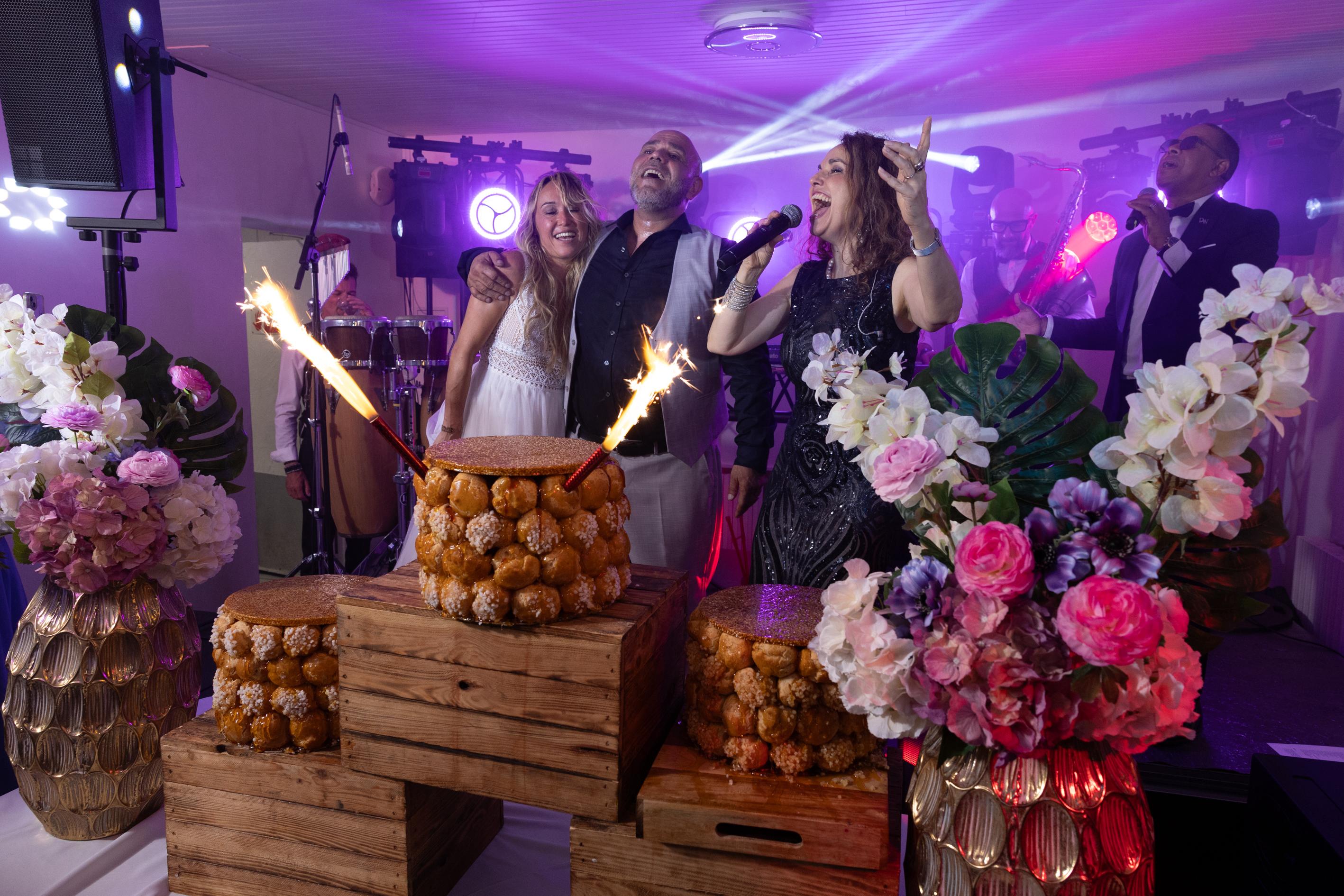
We performed as a full orchestra that night, with brass, a complete band, and three singers. The dance floor opened with real intensity for about ninety minutes, and the American guests fully joined in. But by half past two in the morning, they began leaving to go to bed. The couple had planned, and already paid for, an after party with a DJ to follow. It never really happened. The American guests were gone, and the moment collapsed. In a French wedding, guests often keep dancing until four or five in the morning. That was very likely part of the bride's vision for her own wedding night, but with a largely American crowd already worn down by a five hour dinner, it simply was not realistic.
What This Actually Means for Planning Your Own Timeline
The lesson here is not that one timeline is better than the other. It is that mismatched expectations, not bad execution, cause these moments to fall flat. A five hour dinner is completely normal, even wonderful, for a French crowd used to lingering at the table. For a majority American guest list, that same five hour dinner can consume the energy that was meant for the dance floor later on.
If you know your crowd will be mostly American, it is worth deliberately shortening the dinner, even in a French setting with a French caterer, so that energy remains for dancing rather than being spent at the table. If your crowd is mostly French, or genuinely split, leaning into the traditional French pace, longer dinner, later dancing, tends to serve everyone better, since it matches what most of the room is expecting.
Ask about planning your own French wedding timeline
How Should You Decide Which Timeline Fits Your Wedding?
Start with your guest list, not your personal preference. If the majority of your guests are American, an American style schedule, ceremony, one cocktail hour, a shorter dinner, several hours of dancing, ending by midnight, will likely keep more people engaged and on the dance floor until the end. If your crowd is heavily French, the traditional late night structure will feel natural rather than exhausting. If your guest list is genuinely mixed, as in the Brittany wedding above, it is worth having an honest conversation with your planner and your caterer about where to compromise, since trying to run a full French length dinner and still expect an American crowd to have the stamina for an after party afterward is where things tend to break down.
Whatever you decide, the timeline needs to be communicated clearly and early to every vendor involved, particularly your caterer, since a French wedding running on autopilot will always default to the longer, more traditional French rhythm unless someone has specifically asked otherwise.
In Practice
There is no single right way to structure a wedding timeline in France. What matters is choosing deliberately, based on who is actually in the room, rather than assuming your vendors will adapt automatically. A shorter, American style evening and a long, traditional French one can both be genuinely beautiful. The wedding that struggles is the one caught between the two, with a dinner long enough to exhaust an American crowd before the night's real celebration even begins.
Talk to Nourith about planning music around your wedding timeline
Read next
- What Is a Reasonable Budget for a Wedding DJ in France?
- How Much Does a Live Musician Cost for a Wedding Ceremony?
- Live music for your event